Pages

Showing posts with label Tutorials. Show all posts
Sunday, May 3, 2015

A New (to me) Way To Refurbish Old Dress Shoes


Can you believe these are the same shoes?
We bought them at Gap in August 2014.
Carolina needed some shoes to wear in the beauty pageant, and these were the perfect shade of pink.
She loved them.  As you can see she nearly loved them to death.
When the recent beauty pageant rolled around and Carolina needed new shoes I was faced with the daunting question, "Do I take these 5 children out shoe shopping for a new pair of dress shoes for Carolina?  Or do I figure out how to make her current dress shoes work?"  
It didn't take a split second to know that I had no interest in taking my boys shoe shopping for a girl unless absolutely necessary.  There would be too much whining, running, and overall mayhem if I take them to a series of stores.  I thought I remembered seeing someone refurbish some old shoes during a season of Project Run and Play some time ago.  I quickly started the task of scrolling through each and every post on their blog page, in an effort to find what I was looking for.
I did not find it.  But I did find this awesome shoe project.
I like the author a lot.   She has a blog over at www.cathgrace.com  .
I have pinned more than one thing she did on Project Run and Play.
I followed this tutorial with some slight changes.
I took pictures along the way so I can share the experience with anyone that would like to try it.
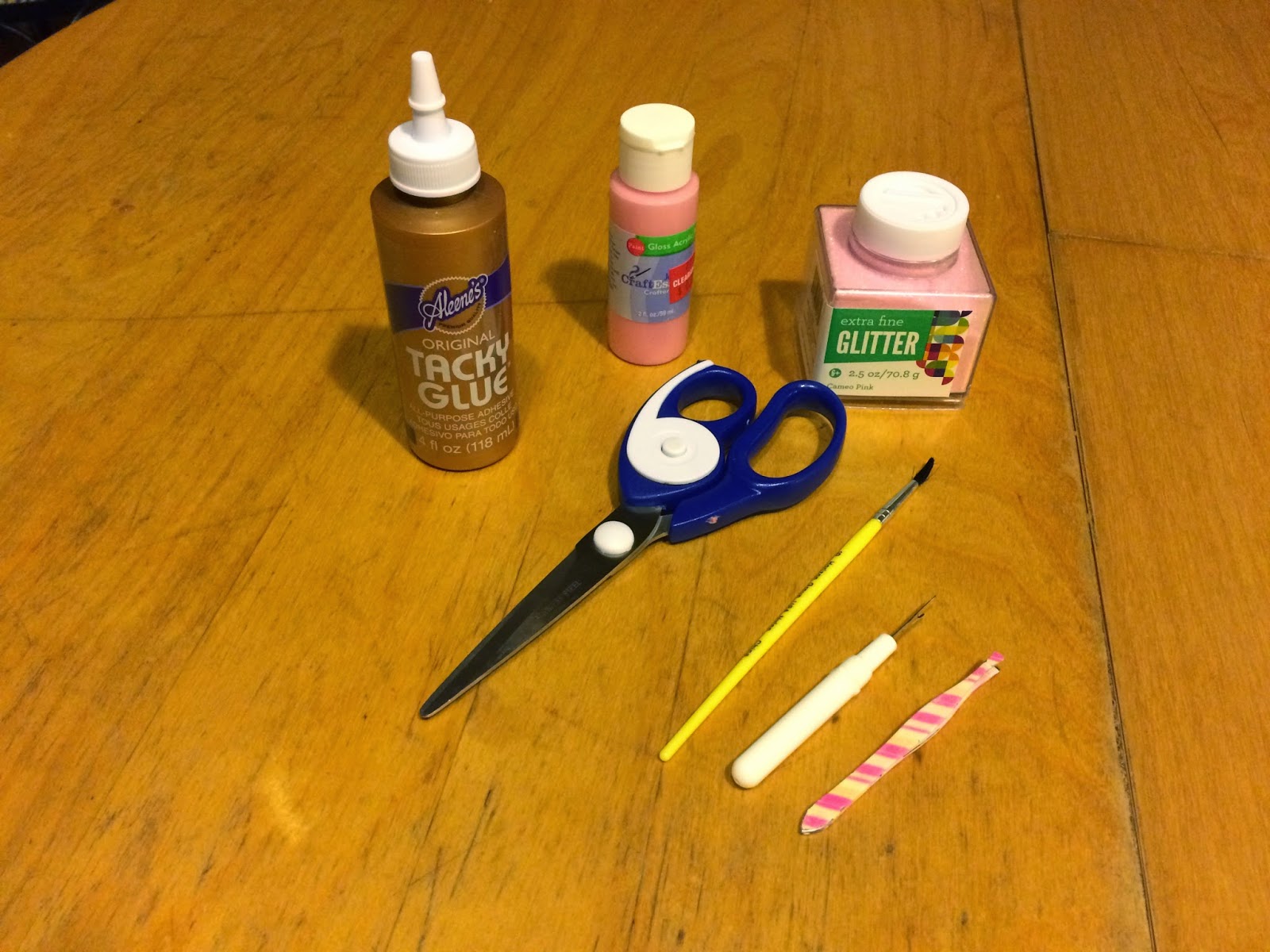
 Some things you'll need are tacky glue, craft paint, fine glitter, scissors, paint brush, seam ripper, and tweezers.  Not pictured: fleece or felt, needle and 8lb test fishing line, or jewelry making nylon thread, two sizes of beads, embroidery hoop and scrap of cotton fabric to use as stabilizer.


These shoes were so cute when we bought them.  
That's why she wore them every chance she got.

First, remove the pink turned brown ribbon and flower.

The first thing I did was take my closest matching craft paint and paint the shoes.  
I wanted to just cover the scuffs, but the shade was darker, so I had to go ahead and cover the whole shoe.  I was worried this could cause problems with chipping and coming off, but that hasn't been the case.

I took the tacky glue and mixed it with water. 50/50
This made it thinner and more manageable.
Then I painted the dried, painted shoes with it and covered them in the glitter.

 I did 3 coats of glitter.

For the heart shaped beadwork I followed the tutorial by Catherine from www.cathgrace.com very closely with slight differences.  She used felt under the beads and I used fleece.   Because that's just what I had on hand.

Always upcycling where I can I was able to use the small clear beads from this necklace.
My friend Erica gave this to me 5 or 6 years ago when she cleaned out her jewelry box.  She gave me several things that the kids would play dress up with.  But this one had been abandoned in my room for quite some time now.  It was time to give it a new purpose.  The other beads used are ones I purchased from my craft supply store.  Light pink glass beads.

OK, so what you see here is I'm sewing the beads to the heart shaped fleece.
Using the nylon thread, or fishing line, bring your needle up through the fabric, up through a larger bead, up through the smaller bead, over the side of the smaller bead, back down through the larger bead and finally back down into the fabric.  
Repeat until you can't get another bead sewn onto the heart. (Or whatever shape you are using)

Now cut them out and glue them onto the front of your glittered shoe.
Use the tacky glue (not mixed with water) to do this.  I used large paper clips and clothes pins to press them while the glue dried.

That's it!  

Now try keeping her out of them.


Easy Bath Apron Tutorial

I just got done converting all of our hooded baby towels into bath aprons.

Bath apron

I saw bath aprons on Pinterest in recent years.  I pinned one that was made from a regular bath towel, but we already have several hooded baby towels.  I knew I would be using those.  


It was really simple actually.  Using scraps of ribbon stuffed into my ribbon basket I just took ones that were about a foot in length and sewed one on each side of each hood.


You just tie the ribbons around your neck, then you already have a towel in place when it's time to get your baby out of the bath.  No reaching/dropping/sweating bullets while keeping hold of the baby and grabbing a towel at the same time. 


Thanks for checking it out.  What did you work on this weekend?
Sunday, April 12, 2015

Delsin's Lumbar Pillow and Piping Chord Tutorial


He picked out the pillow at Fabric World in Atlanta at Christmas.  I finally got around to making a cover for it using the Li'l Cowpokes fabric.  I bought way too much of this fabric.  I would like to make up a bunch of things to sell.  After I make curtains and a quilt or two.


I was excited to get to upcycle a couple pairs of pants for this project.


The "mudd" label was too perfect to remove.  It's reflective of my day.  Kids playing in mud and me complaining about it getting tracked onto my freshly cleaned floors.  Those pockets came off of a pair of Carolina's old pants.  I also rescued some cute embroidery of flowers that was on the pant leg.  I hope to use it in some future project.  Maybe the Project Run and Play bag that's the challenge for this month.  The denim underneath the pockets came off of a pair of Kai's pants.


The piping fabric was a suede looking fleece.  It was in with a bag of fabric I bought at a yard sale at least 6 years ago. It was all samples.  Not quite a fat quarter, but enough to make a few things.


I tried the shoestring trick for the cording for this piping.  If you remember I posted recently about making shoestrings out of an old t-shirt.  So I cut a 1" wide length of  t-shirt.  


Then stretched it to make it curl up.  


Finally, I wrapped a 1" wide strip of my piping fabric around it and stitch.  And I had my own custom piping and upcycled a t-shirt that was to be disposed of.


Thank you for checking it out.  
What have you been working on?
Monday, February 9, 2015

Double Sided Door Draft Stopper Tutorial


This is the bottom of our basement door.
For the past 4 winters, as long as we've lived here I've been wanting to make a door stopper to keep the draft from coming up from the basement.

Tonight that became a finalized reality.
And now I'm about to tell you how to make one for your own drafty door.


You will need:
-Something to stuff each side of this door draft stopper with.  I used an old towel.  I have seen some with water pipe insulation, but I used an old towel for mine.
- A pair of scissors.
-Needle and thread
- Cute fabric for the cover. 1/2 a yard should be plenty.  I used the legs cut off of some old pajama pants.  I love to upcycle.
-A cute helper doesn't hurt.  I wanted to take this opportunity to let my 4 year old get a little sewing experience.

Step 1:
Hold your towel up to your doorway and cut the ends off of each side to make it match the width of the doorway.
Next you are going to roll up the long sides of the towel, until you get to the center of the towel.  Make sure to leave space for the bottom of the door between your rolls.  You can add the pieces you cut off of the ends of the towel to the inside of the rolls, by laying the cut pieces down lengthwise on the sides of the towel.

Step 2:
Stitch the rolls into place, by hand.
Your little helper can do this too.

 Just be sure to warn him or her beforehand about the fact that they WILL prick their fingers, and it WILL hurt.  But it won't hurt for long and that's just part of sewing.
Everybody does it.
Poor tough little girl.  She was so proud that she didn't quit.
I sewed down one side, while she did the other.
Then of course I helped her on her side.

Step 3:
Get your cover ready.
My mom recently sent me a box of clothes for the kids.
Inside was a grocery bag full of the bottoms of pajama pants.
Someone had cut them off to make pajama shorts, and I got the scraps.
Nice!
Thanks Mom!
I just put one pant leg inside the other with the right sides of the fabric facing and stitched the raw edges together to make one long tube.
If you are simply using fabric you bought at the store, then just wrap it around the towel and leave yourself about 1/2" of seam allowance.
Step 4:
Then I slipped the towel inside the tube and pinned to show where I wanted my seams to go.
I've got the cover turned inside out for this step.

Step 5:
Sew the side and one edge along the outline shown by the pins.

Step 6:
Flip it right side out and slip it over the door draft stopper (towel portion).
Now sew closed the end of thecover, and zig zag stitch up the middle, where it will fit under the door.

And now it's done!
So darn easy, and it took me so darn long to sit down and get it done.
Shame, shame, shame it took me so long to make this.

Thanks for checking my blog out!
Monday, January 26, 2015

Tiered Bubble Dress Tutorial


I just love this dress.
I guess I like layers on dresses.  This makes the third dress I remember doing it on, and it's right up there with the other two as being one of my favorites. 
The other two were Kai's pageant dresses.

But enough about all that.  You want to know how to make one of these for your own, so here it goes.
First of all I knew I needed to know the basics of making a bubble skirt.
I looked at a couple of tutorials for this.
1. Alida's Bubble Dress Tutorial was featured on the Project Run and Play page as the dress to use for our inspiration when making this month's project. 

2.  I also referred to and ultimately got more information for this particular skirt from Simple Simon's Bubble Skirt Tutorial.
 I used this site to learn how to measure my fabric cuts.  The only difference between what I did and what they did is that in addition to cutting fabric for a bubble skirt.  I cut another layer 3 inches shorter than the first for the middle layer and a third layer 3 inches shorter than the second.  I cut it from both the outer fabric and the lining too.
I don't have a picture of my fabric cuts, because it didn't occur to me that I was going to do a tutorial until after I sewed the skirt together.  
I should also note that I did not follow the Simple Simon tutorial for the waist band.  So if you are making my dress, omit that part.

So, my recommendation would be to follow the Simple Simon Tutorial for the skirt x 3 because we are making 3 layers.  Then match the top of each layer up and sew around the top.  I finished each layer top with a zig zag stitch.  I don't use a serger.  I did so to keep unsightly strings from unraveling and hanging around.  Makes it all neat and pretty and more sturdy seams when to attach the skirt to the bodice or waist band.

The skirt inside out...

Next, I took a dress that Carolina already had in her closet (one my sister made for Kai, a few years ago) and traced around the bodice pieces, but I changed the back of this dress up from being one piece to making it two pieces.  Two things to remember when doing this...
1.  Go an extra 1/2 inch out from the piece you are using for a pattern to make room for your seam allowance.
2.  If you are changing the back of the dress, add an extra 1 to two inches to the middle of the back for buttons.  You need extra fabric folded under where the buttons and button holes are going to be.
I don't like cutting and adding on interfacing if I don't need to.  This is simple.  Just cut it extra wide on the side of the bodice piece that will be in the middle of the back and fold it under once or twice.

Now you are going to sew the back bodice pieces to the front bodice pieces at the shoulder.  Do this for your outer fabric and your lining fabric.
In the photo above the front of the dress is on the top of the photo and the back is on the bottom.

Next cut your sleeves.  Again, I used a sleeve on a dress in Carolina's closet to use as my pattern.
I wanted a puffier sleeve though, so I traced a little more than 1/2 inch from the sleeve I was using as a pattern.  Sleeves are so forgiving because you can just gather them where you are going to sew them to the shoulder.  And this is what I did to make it puffier.
Be sure to cut it on a fold, so there is no seam on the top of the sleeve, only the bottom.

This is what your cut should look like.

If you aren't familiar with how to gather.  You need to set your sewing machine (or you can do this by hand) on the longest stitch you can.  Unfold your sleeve fabric and where the curve starts, start sewing your straight stitch.  This is called a basting stitch.  Simply sew to the other curve.

Now, with right sides of your fabric together pin the center of the top of the sleeve to the shoulder seam.  Pin the ends of the sleeve to the sides of the bodice, and pull your strings of the basting stitch to make the sleeve gather till it fits within the arm of the bodice.  And pin it.

Stitch it together and remove the pins as you go.
It should look similar to this when you are done.  Nevermind the white strips of fabric around the bottom of the bodice pieces in the next couple of photos.  I had changed my mind about my design and took that off before finishing the dress.  Don't forget to finish your edges with a zig zag or overlock stitch as you go to keep your fabric from getting stringy when you wash.

Next,  you will sew down the sides of your sleeves and bodice.  Just match up the right sides and start at the sleeves to make sure they match up nicely and sew straight down till you get to the end of the side of your bodice.  Do this on both sides.
It's starting to take shape, huh?

Now to hem your sleeves.  I cut mine on the selvage, so I just folded it under once, but if you didn't do that you'll need to fold it under twice then stitch.

Now you are ready to sew your lining to the inside of your bodice.  Make sure you match the right sides together and pin around the neck and back of the bodice.  If you left an extra inch or two at the back of the bodice for strengthening the place where your buttons and button holes will go, then be sure to allot for that in your seam allowance back there.

Now you need to clip the edges of the corners and snip little nicks into the fabric (not past the stitch you just made) around the curve of the neck, so that it lays down nicely when you turn the bodice right side out.

Now, I don't always do this, but for some reason I decided I didn't want any raw edges of lining inside this dress, so I folded it under and top stitched around the sleeves.
I just wanted it to look polished inside and out.

Now it's time to make the middle of the dress.
Here is what I did.  First I took my 1/4" elastic and my little girl and stretched it around her waist till we reached an agreed comfort level.
Then I cut it where it needed to that length, plus 1/2 inch for seam allowance.
Next, I measured how wide I wanted the waistband to be, plus 1/2 inch on top and bottom for seam allowance.  
Then I stretched that piece of elastic out onto the waistband fabric until I got it was not quite all the way tight.  Just a little less than fully tightly stretched.  I marked it on the fabric and cut my fabric by that length and width I just figured.
And I cut 4 more pieces of elastic.
Finally I spaced them out equally the length of the waistband and zig zag stitched them into place.  Stretching them as I sewed.
Then I sewed the ends together to make a circle and pinned it to the bodice, stretching it as needed.
Stitched it into place.  Make sure to overlap the back of the bodice accordingly for the buttons and button holes and you may want to stitch it together there before you sew the waistband on.  That's what I did.
Then did the same for the skirt portion of the dress.
The lining of my bodice covers the top of the waistband, but not the waistband it's self.


Finally, I added the buttons and button holes last.  
I always put the buttons on first.  It's just easier to me to see how to space them apart that way.
Then I mark the tops of the buttons on the other side and sew my button holes on.


One more thing.  To make the rose I followed this tutorial.

And that's it!
I hope I covered everything well.
Please put any questions you may have in the comments below.
Thank you for visiting my blog page!